Yagel Numbers: the Mersenne × Primorial Grid — Structure, a Lucas–Lehmer-Type Test, and Certified Prime Hunting
This is a living document. Revision 1.0 appeared October 23, 2024; the present revision reports the family's structure theory, its deterministic test, and the computational campaigns of June–July 2026. Data, tools, and the changelog live in the project repository (yagelnumbers.org).
1. Introduction
Mersenne numbers $M_n = 2^n - 1$ owe their role in prime hunting to two gifts: an algebraic one — a divisor $2^d-1 \mid 2^n-1$ for every $d \mid n$, so only prime exponents need testing — and an arithmetic one — the Lucas–Lehmer test, which decides the primality of $M_p$ with one quadratic recurrence modulo $M_p$. It is natural to ask what becomes of these gifts when the sieve idea behind Mersenne numbers ("exclude divisibility by 2") is pushed to its logical extreme.
Fix $k \ge 1$ and let $p_k$ denote the $k$-th prime, $p_{k-1}\# = \prod_{j
$$Y_k(n) \;=\; p_{k-1}\#\cdot p_k^{\,n} \;-\; 1 \;=\; 2\cdot 3\cdot 5\cdots p_{k-1}\cdot p_k^{\,n} - 1, \qquad k, n \ge 1. \tag{1}$$
The construction removes divisibility by every prime up to the base: the primorial coefficient kills the primes below $p_k$, the power $p_k^n$ kills $p_k$ itself (§2.1). Two classical families appear as the boundary of the grid:
- row $k = 1$: $Y_1(n) = 2^n - 1$, the Mersenne numbers;
- column $n = 1$: $Y_k(1) = p_k\# - 1$, the primorial numbers, whose primes are the primorial primes studied since Dubner [7] and Caldwell–Gallot [8].
Both "constants" in (1) are dictated by the prime sequence itself; the family has no free parameters and is indexed purely by the lattice point $(k, n)$. The genus is classical: numbers $c \cdot b^n - 1$ with fixed coefficient and base have been studied since Lucas, with Riesel ($c \cdot 2^n - 1$), Williams ($(b{-}1)b^n - 1$), and their $+1$ mirrors (Proth, Sierpiński, Thabit) as the familiar branches — and we claim nothing beyond that placement. What singles $Y$ out within the genus is that the coefficient is not one of infinitely many arbitrary choices of $c$ but the parameter-free one, $c = p_{k-1}\#$, coupled to the base $b = p_k$: the unique specialization in which the coefficient does maximal sieving work for its base (§2.1) and the adjacent integer is fully factored at every cell (§2.3). The result is a natural two-dimensional table whose edges are Mersenne and primorial numbers and whose interior appears not to have been treated as a single object before.
Notation and nomenclature. Following the convention of Lucas sequences and Chebyshev polynomials, we call $Y^-_k(n) = p_{k-1}\#\,p_k^n - 1$ the Yagel numbers of the first kind and $Y^+_k(n) = p_{k-1}\#\,p_k^n + 1$ the Yagel numbers of the second kind; an unmarked $Y_k(n)$ always means the first kind (the historical default of Revision 1.0). Informally, as in the Cunningham tables' "$-$ side / $+$ side", we speak of the $-1$ and $+1$ faces of the grid around the central column $M = p_{k-1}\#\,p_k^n$. The second kind has classical edges of its own: its $n = 1$ column consists of the Euclid numbers $p_k\# + 1$, and its $k = 1$ row is $2^n + 1$, prime at most when $n$ is a power of two — the Fermat form (see §4.5).
This paper presents the family from three angles.
Structure (§2). The sieve property is maximal; the interior admits no algebraic factorization in the exponent (a Capelli-type lemma), so every lattice cell is a live candidate — in sharp contrast to the Mersenne row, where composite exponents are disqualified; and both neighbors $Y \pm 1$ of the central point $M = p_{k-1}\# p_k^n$ come fully factored.
A deterministic test (§3). Because $N + 1$ is fully factored, the classical Brillhart–Lehmer–Selfridge theory applies to every member. We state and prove the test in its sharpest form for this family: in the one-ladder regime $p_k^n \ge p_{k-1}\# + 2$ (all but finitely many cells of each row), primality of $N = Y_k(n)$ is decided by a single $V$-only Lucas ladder — an $n$-fold iteration of the degree-$p_k$ Chebyshev-type map $V_{p_k}$, seeded at $V_h(P)$. For $k = 1$ the map is $V_2(x) = x^2 - 2$ and the criterion collapses to the Lucas–Lehmer(-Riesel) test verbatim. The cost is about two multiplications per bit, roughly three Fermat tests, and the output is a proof, not a probability.
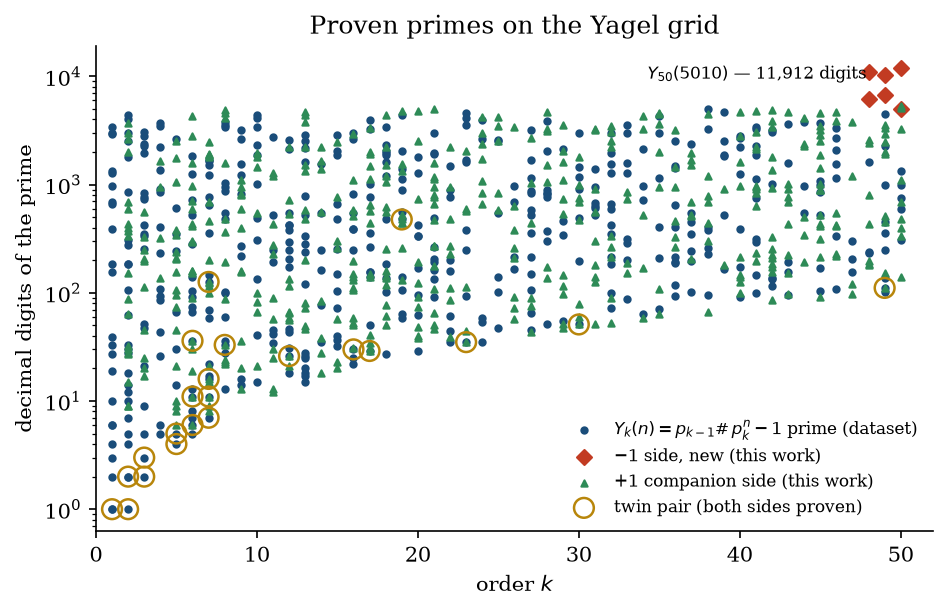
Statistics and computation (§4–5). On the exhaustive dataset ($k \le 50$, all numbers to 5000 digits; 476 primes, each certified) the sieve-adjusted prime-counting model fits without free parameters, in aggregate and row by row; the Mersenne edge alone carries Wagstaff's additional divisor-class enrichment; prime exponents give the interior no advantage, as the structure predicts; and twin pairs $(M - 1, M + 1)$ occur at the Hardy–Littlewood-adjusted rate. Running the same machinery forward (§5) yielded certified records — largest $Y_{50}(5010)$, $11{,}912$ digits, whose exponent $5010 = 2\cdot 3\cdot 5\cdot 167$ is emphatically composite — a certified census of the $+1$ face, and 22 doubly-certified twin pairs.
Throughout, we are explicit about what the family does not offer (§6): the test, like Lucas–Lehmer, is $\tilde O(B^2)$ per candidate, and Mersenne retains a constant-factor advantage (its $\Theta(B)$ special reduction and its divisor-class enrichment). The family's genuine assets are universality of certificates, density of live cells, and canonical two-parameter indexing.
2. Structure of the grid
2.1 The maximal small-prime sieve
Proposition 1. For every prime $q \le p_k$, $\;Y_k(n) \equiv -1 \pmod q$. In particular $\gcd(Y_k(n), p_k\#) = 1$: no prime up to the base divides any member of row $k$.
Proof. If $q < p_k$ then $q \mid p_{k-1}\#$, and if $q = p_k$ then $q \mid p_k^{\,n}$; in both cases $q \mid Y_k(n) + 1$. $\square$
This is the strongest clean congruence sieve available for the base: an integer $\equiv -1$ modulo every prime up to $p_k$. Quantitatively, coprimality to the first $k$ primes multiplies the prime density of a random integer of the same size by Mertens' factor
$$S_k \;=\; \prod_{q \le p_k} \frac{q}{q-1} \;\sim\; e^\gamma \ln p_k , \tag{2}$$
which is the precise form of the intuition that the construction "amplifies" prime density (explicit estimates for (2) in Rosser–Schoenfeld [11]); §4 tests it against the data.
2.2 Every cell is live: no algebraic exponent filter
The Mersenne row loses all composite exponents to the identity $2^d - 1 \mid 2^n - 1\ (d \mid n)$. The interior loses nothing:
Lemma 2. For $k \ge 2$, the polynomial $h\,x^n - 1$ with $h = p_{k-1}\#$ is irreducible over $\mathbb Q$ for every $n \ge 1$.
Proof. The reversal of $h x^n - 1$ is $-(x^n - h)$, and reversal preserves irreducibility. By Capelli's theorem (see, e.g., Lang [9, Thm. VI.9.1]), $x^n - h$ is reducible over $\mathbb Q$ only if $h$ is a $q$-th power for some prime $q \mid n$, or $4 \mid n$ and $h = -4c^4$. A primorial with $k \ge 2$ is squarefree and greater than 1, hence never a perfect power, and it is positive. $\square$
So no polynomial identity in $p_k$ can divide $Y_k(n)$ for composite $n$: every exponent is a live candidate. The mechanism behind Mersenne's prime-exponent rule is exclusive to $h = 1$. One can see the same fact locally: a prime $q > p_k$ divides $Y_k(n)$ exactly when
$$n \;\equiv\; t_q \pmod{\operatorname{ord}_q(p_k)}, \qquad t_q \;=\; \operatorname{dlog}_{p_k}\!\big(h^{-1} \bmod q\big), \tag{3}$$
a shifted arithmetic progression in $n$. For $h = 1$ all shifts vanish and divisibility aligns with the divisor lattice of $n$; for $h > 1$ the shifts $t_q$ decouple divisibility from the multiplicative structure of $n$ entirely. §4.3 confirms statistically that prime exponents indeed confer no advantage — and three of the records in §5 have composite exponents.
(Two honest caveats. Lemma 2 rules out polynomial identities, not covering systems: a hypothetical far row could still be Sierpiński–Riesel-style barren by a finite set of primes covering all residues (3); rows $k \le 50$ visibly are not. And Aurifeuillian-type numeric factorizations require cyclotomic values, which (1) does not produce.)
2.3 Both neighbors factored
The central object of cell $(k, n)$ is $M = p_{k-1}\#\cdot p_k^{\,n}$, with complete factorization known by construction. Its two neighbors are
$$M - 1 = Y_k(n) \quad (\text{"}-1\text{ face"}), \qquad M + 1 = Y^{+}_k(n) \quad (\text{"}+1\text{ face"}),$$
and for both, the adjacent number is fully factored: $N + 1 = M$ for the $-1$ face, $N - 1 = M$ for the $+1$ face. Consequently the classical $N+1$ (Brillhart–Lehmer–Selfridge / Morrison [1, 3]) and $N-1$ (Pocklington [4]) theories give every prime in either face a deterministic certificate at Lucas-chain cost — and when both faces are prime at the same cell they form a twin pair in which each member certifies cheaply (§4.4). This "always provable" property is what generic members of the $c\, b^n \pm 1$ genus lack unless $c$ happens to factor.
3. A Lucas–Lehmer-type test for every row
Throughout this section $N = Y_k(n) = h\, p^n - 1$ with $h = p_{k-1}\#$, $p = p_k$, and Lucas sequences $U_m, V_m$ have parameters $(P, Q)$ with $Q = 1$, $D = P^2 - 4$, i.e. $V_0 = 2$, $V_1 = P$, $V_{m+1} = P V_m - V_{m-1}$. Two classical facts (work in $\mathbb F_{r^2}$ for a prime $r \nmid 2D$, with $\omega = \alpha/\bar\alpha$ for the roots $\alpha, \bar\alpha$ of $x^2 - Px + 1$):
- $U_m \equiv 0$, resp. $V_m \equiv 2$, resp. $V_m \equiv -2 \pmod r$ iff $\omega^m = 1$, resp. $1$, resp. $-1$;
- $\operatorname{ord}_r(\omega)$ divides $r - \left(\tfrac{D}{r}\right)$.
Because $Q = 1$, the $V$-sequence is closed under composition of indices: $V_{cm}(P) = V_c(V_m(P))$, where $V_c(x)$ is a monic degree-$c$ polynomial — the Chebyshev polynomial up to scaling, $V_c(2\cos\theta) = 2\cos(c\theta)$ — evaluated modulo $N$ by a two-term "ladder" in $2\lceil\log_2 c\rceil$ modular multiplications, with no $U$-values needed.
Theorem 3 (one-ladder test). Let $p$ be an odd prime, $p \nmid h$, and $p^n \ge h + 2$. Suppose $P \ge 3$ satisfies $\gcd(2D, N) = 1$ and $\left(\tfrac{D}{N}\right) = -1$. Define
$$s_0 = V_h(P) \bmod N, \qquad s_{i+1} = V_p(s_i) \bmod N \quad (0 \le i < n),$$
so that $s_i = V_{h p^i}(P) \bmod N$ and $s_n = V_{N+1}(P) \bmod N$. If
$$\text{(i)}\;\; s_n \equiv 2 \pmod N \qquad\text{and}\qquad \text{(ii)}\;\; \gcd(s_{n-1} - 2,\, N) = 1,$$
then $N$ is prime. Conversely, if $N$ is prime then (i) holds for every admissible $P$, and (ii) holds for a fraction $1 - 1/p$ of them.
Proof. Let $r$ be any prime factor of $N$. By (i), $V_{N+1} \equiv 2 \pmod r$, so $\omega^{N+1} = 1$ in $\mathbb F_{r^2}$. By (ii), $V_{(N+1)/p} \not\equiv 2 \pmod r$, i.e. $\omega^{(N+1)/p} \ne 1$; and $\omega^{(N+1)/p} = -1$ is impossible because its $p$-th power would be $-1 \neq 1$ for odd $p$. Hence the $p$-adic valuation of $\operatorname{ord}_r(\omega)$ equals $v_p(N+1) = n$, so $p^n \mid \operatorname{ord}_r(\omega) \mid r - \left(\tfrac{D}{r}\right)$, giving $r \ge p^n - 1$ for every prime factor $r$. If $N$ were composite it would have two such factors and $N \ge (p^n - 1)^2 > h\,p^n - 1 = N$ under $p^n \ge h + 2$, a contradiction. For the converse: if $N$ is prime and $\left(\tfrac{D}{N}\right) = -1$, then $\omega^{N+1} = \operatorname{Norm}(\omega) = 1$, which is (i); the norm-one subgroup of $\mathbb F_{N^2}^\times$ is cyclic of order $N + 1 = h p^n$, and (ii) fails only when $\omega$ is a $p$-th power in it, a subgroup of index $p$. $\square$
Remarks.
- Lucas–Lehmer is the $k = 1$ member. For $p = 2$ the map is $V_2(x) = x^2 - 2$ and the sign analysis changes at exactly one point: $\omega^{(N+1)/2}$ is a square root of unity, hence $\pm 1$, and the good case is certified by $s_{n-1} \equiv -2 \pmod N$ (which subsumes (i) by squaring). Iterating $x^2 - 2$ from a seed of the right quadratic character and demanding the penultimate value $\equiv -2$ — equivalently the antepenultimate $\equiv 0$ — is the Lucas–Lehmer test for $h = 1$, and the Lucas–Lehmer–Riesel test with its $V_h(P)$ seed for $h > 1$ [2, 5]. The grid thus carries one family of iterated Chebyshev maps, $x \mapsto V_{p_k}(x)$, of which the celebrated $x \mapsto x^2 - 2$ is the first row.
- Certificates, retries, exactness. A composite $N$ can never pass: (i) failing is an exact compositeness witness, a proper gcd in (ii) is a factor, and gcd $= N$ in (ii) merely rejects the seed (a "$p$-th power" seed; expected retries $\le p/(p-1)$, Las Vegas — verdicts are never probabilistic). For $N$ prime a valid seed is found immediately in practice ($P = 4$ or $5$ typically).
- Below the threshold. The regime $p^n \ge h + 2$ — equivalently $n \ge n_0(k) \approx \ln p_{k-1}\# / \ln p_k \sim p_{k-1}/\ln p_k$ by the prime number theorem — covers all but an initial segment of each row ($n_0(50) = 38$; a $Y_{50}$ candidate at $n_0$ has 179 digits). Below it the same machinery applies with more factored primes of $N + 1$ carried until the certified part exceeds $\sqrt N$ (Brillhart–Lehmer–Selfridge [1]); at most $k$ short ladders.
- Cost. The ladder spends $2\lceil\log_2 p\rceil$ multiplications per step and $n$ steps: about $2 \log_2 N$ multiplications total, versus $\approx 0.7\log_2 N$ squaring-equivalents for one Fermat test — a proof for roughly the price of three PRP tests, at the same $\tilde O(B^2)$ bit complexity as Lucas–Lehmer. What the grid does not inherit is Mersenne's $\Theta(B)$ modular reduction: reduction modulo $h p^n - 1$ folds high limbs multiplied by the dense constant $h^{-1} \bmod N$, and no shift-like shortcut is known (§6).
- Empirical validation. An implementation re-certified all 476 dataset primes in the one-ladder regime and rejected 100 composite controls with zero disagreements; observed seed retries matched the $1/p$ prediction. At scale, the ladder certified the $11{,}912$-digit record of §5 in 17.7 s (single seed, $P = 4$) on commodity hardware — faster in practice than the equivalent $U$-sequence BLS routine (55.6 s).
4. Statistics of the grid
The dataset underlying this section is exhaustive for $k \le 50$ and all $n$ with $Y_k(n) < 10^{5000}$ (146,000+ cells; 476 primes, every one of which now carries a deterministic certificate). Except where stated, windows are 100–5000 digits — wide enough that boundary effects and the heuristic's small-$N$ breakdown are immaterial.
4.1 The sieve-adjusted null fits — with no room for mystery
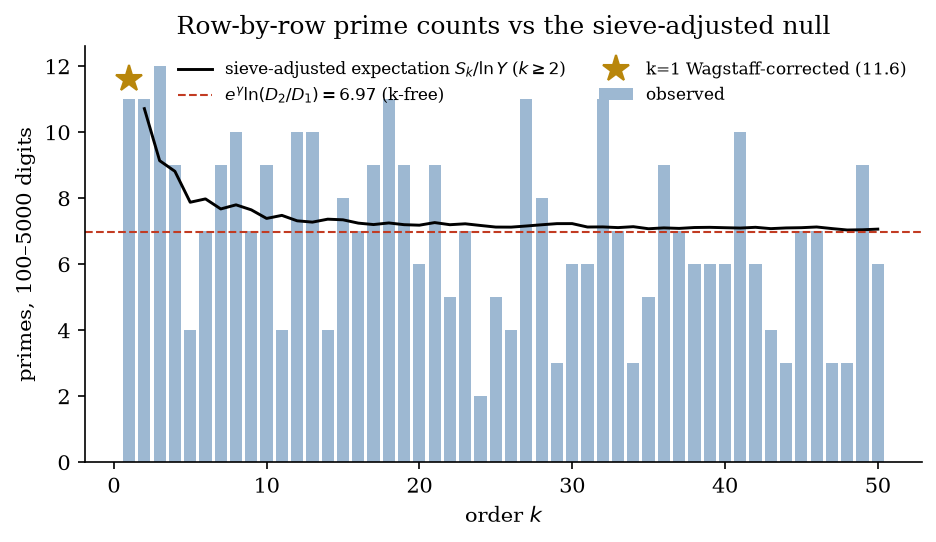
The correct null model for a family satisfying Proposition 1 is not the bare prime number theorem but PNT conditioned on the built-in sieve: a candidate of size $Y$ is prime with probability $\approx S_k / \ln Y$ with $S_k$ from (2) — computed exactly, not asymptotically. Expected counts per row are then $E_k = \sum_n S_k / \ln Y_k(n)$ over the window.
Result. Over $k \in [2, 50]$: observed $340$ primes against expected $361.8$; Poisson $z = -1.15$; every individual row has $|z| < 2$ (Fig. 2). The family is exactly as prime-rich as its sieve entitles it to be — the "higher than expected density" of Revision 1.0 is fully accounted for by the Mertens factor (2), and nothing is left over.
A pleasant closed form follows from $E_k$: over a digit window $[D_1, D_2]$,
$$E_k \;\approx\; \frac{S_k}{\ln p_k}\,\ln\!\frac{D_2}{D_1} \;\approx\; e^\gamma \ln\frac{D_2}{D_1}, \tag{4}$$
independent of $k$ — the Mertens boost cancels the thinning from the larger base. For the window of Fig. 2 this predicts $e^\gamma \ln 50 = 6.97$ primes per row; the observed counts indeed cluster around 7 with Poisson scatter, across all fifty rows.
4.2 The Mersenne edge is different in kind — measurably
Row $k = 1$ under the naive restricted null (prime exponents only, probability $2/\ln M_q$) predicts only $1.5$ primes in the window; $11$ are observed. The discrepancy is Wagstaff's [6]: divisors of $2^q - 1$ lie in the classes $\pm 1 \bmod 8$ and $1 \bmod 2q$, enriching surviving candidates by a factor $\sim e^\gamma \log(aq)/\log 2$. The corrected prediction is $11.6$ — against 11 observed. The interior rows, by contrast, fit without any such correction: divisors obey the shifted-progression law (3), which averages out. The grid thus cleanly separates the two Mersenne gifts: the edge keeps its divisor-class enrichment; the interior trades it for Lemma 2's universality of live cells.
4.3 Prime exponents confer nothing in the interior
The structural prediction of §2.2 is quantitative and testable: split all interior cells ($k \ge 2$, $n \ge 2$) by the primality of the exponent and normalize each group by its summed sieve-adjusted expectation.
| exponent $n$ | cells | observed | expected | $z$ |
|---|---|---|---|---|
| prime | 20,846 | 107 | 108.9 | $-0.19$ |
| composite | 125,790 | 340 | 375.6 | $-1.84$ |
Expectation-normalized rate ratio (prime : composite) $= 1.085$, 95% CI $[0.873,\, 1.348]$: no effect, in either direction. The record primes of §5 make the point concretely — $Y_{50}(5010)$ has exponent $2\cdot3\cdot5\cdot167$, $Y_{49}(4319)$ has $7 \cdot 617$: gigantic primes in cells that do not exist on the Mersenne row.
4.4 Twin pairs, both certified
When both faces of a cell are prime, $(M-1, M+1)$ is a twin-prime pair in which each member has a fully factored neighbor — so both certify at Lucas-chain cost, a property generic twin constructions lack. Scanning the companions of all 476 known $-1$-face primes (Pocklington on $M + 1$) yields 22 certified twin pairs, at
$$(k, n) \in \{(1,2), (2,1), (2,2), (3,1), (3,2), (5,1), (5,2), (6,2), (7,2), (6,6), (7,5), (7,9), (12,9), (17,5), (16,7), (8,21), (23,2), (6,29), (30,3), (49,10), (7,98), (19,248)\},$$
the largest being the pair $\big(Y_{19}(248),\, Y^+_{19}(248)\big) = p_{18}\#\cdot 67^{248} \mp 1$, 476 digits each. The sieve-adjusted Hardy–Littlewood [10] expectation over the tested grid is $27.2$ pairs ($z \approx -1.0$); the deficit is not significant, and row $k = 1$ is algebraically special (only $n = 2$ can twin, and does: $(3,5)$). Twins, too, arrive at exactly the structurally predicted rate.
4.5 The $+1$ face
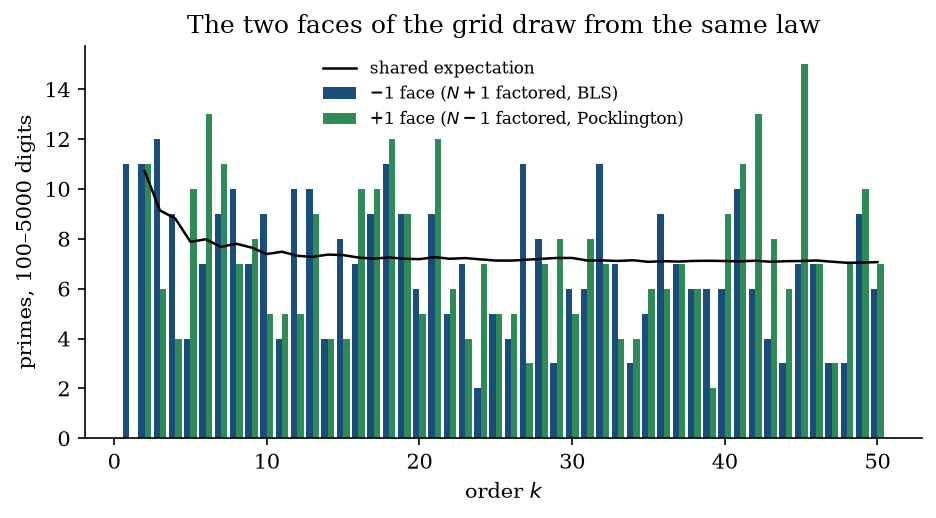
The second kind $Y^+_k(n) = p_{k-1}\#\,p_k^n + 1$ is not a Mersenne generalization — it lives in the $c\,b^n + 1$ branch of the genus — but it is the same grid seen from the other face, and the structure transfers wholesale: it satisfies the same Proposition 1 (with $+1$ in place of $-1$); Lemma 2 holds verbatim ($x^n + h$ is irreducible for all $n$ when $h$ is squarefree $> 1$, by the same Capelli criterion applied to $-h$), so its interior has no dead cells either; and it certifies by Pocklington instead of BLS. Its classical edges mirror the first kind's: the $n = 1$ column is the Euclid numbers $p_k\# + 1$ (Caldwell–Gallot [8]), and the $k = 1$ row, $2^n + 1$, is the one line of the whole two-faced grid that is algebraically gated — $a^d + 1 \mid a^n + 1$ for $n/d$ odd, so only $n = 2^m$ (the Fermat numbers) survive. Both faces thus have exactly one exceptional edge each ($h = 1$), and fully live interiors. The sieve-adjusted model predicts the two faces are statistically identical, and the prediction was registered before running the test: a certified census of the entire $+1$ face over the same grid ($k \in [2, 50]$, all $n$ to 5000 digits) yielded 470 proven primes, of which 356 lie in the 100–5000-digit window against a predicted $361.8$ ($z = -0.31$); the $-1$ face has 340 in the same window ($z = -1.15$). The two faces indeed draw from the same law (Fig. 3), which also doubles the family's certified-prime inventory in one computation — a practical illustration of §2.3: on this grid, finding primes and proving them are the same act. The largest members of the census are $Y^+_{21}(2669) = p_{20}\#\cdot 73^{2669} + 1$ (5{,}000 digits), $Y^+_{42}(2139)$ (4{,}900), and $Y^+_{8}(3806)$ (4{,}873).
5. Certified hunting at scale
The properties of §2–3 assemble into a pipeline in which discovery and certification are the same pass:
- Sieve. For fixed $k$, mark exponents $n$ killed by primes $p_k < q \le L$ via the rolling recurrence $r \leftarrow r\,p_k \bmod q$ against the target residues of (3) — one pass per $q$, both faces simultaneously if desired.
- PRP. Survivors take one Fermat test base 2 (the theoretical minimum: one modular exponentiation), then a BPSW check.
- Certificate. A survivor of step 2 is immediately proven by Theorem 3 (or its Pocklington mirror on the $+1$ face) at $\sim 3\times$ the cost of step 2.
A cost identity parallels (4): at sieve depth $L$, surviving candidates per digit window number $\approx dD \ln 10 / \ln L$ and expected primes $\approx e^\gamma\, dD/D$ — both $k$-free — so **tests-per-prime, $\approx D \ln 10/(e^\gamma \ln L)$, is the same on every interior row.** There is no privileged row to hunt; larger $k$ merely takes fewer, larger exponent steps per digit. (The Mersenne edge is privileged, by precisely its Wagstaff factor of §4.2.)
The first forward campaigns (June–July 2026; commodity 8-core desktop, GMP arithmetic) produced, each entry deterministically certified at discovery:
| number | digits | face | note |
|---|---|---|---|
| $Y^+_{1000}(3918) = p_{999}\#\cdot 7919^{3918} + 1$ | 18,664 | $+1$ | overall record; opener of row $k{=}1000$'s $+1$ face |
| $Y_{50}(5010) = p_{49}\#\cdot 229^{5010} - 1$ | 11,912 | $-1$ | first-kind record; exponent $2{\cdot}3{\cdot}5{\cdot}167$ |
| $Y_{48}(4643)$ | 10,988 | $-1$ | |
| $Y_{49}(4319)$ | 10,263 | $-1$ | exponent $7\cdot 617$ |
| $Y_{49}(2803)$ | 6,691 | $-1$ | |
| $Y_{48}(2617)$ | 6,230 | $-1$ | |
| $Y^+_{50}(2202)$ | 5,286 | $+1$ | |
| $Y^+_{50}(2113)$ | 5,076 | $+1$ | |
| $Y_{50}(2101)$ | 5,047 | $-1$ | exponent $11\cdot 191$ |
| $Y^+_{21}(2669)$ | 5,000 | $+1$ | largest of the $+1$ census (§4.5) |
Opening the rows beyond $k = 50$. As a coverage campaign, we determined the opener of each new row — the smallest $n$ with $Y_k(n)$ prime, proven — for every $k \in [51, 100]$ and for milestone rows $k = 150, 200, 300, 500, 750, 1000$: fifty-six first-of-row certified primes, from $Y_{51}(4)$ ($101$ digits) to
$$Y_{1000}(1098) \;=\; p_{999}\#\cdot 7919^{1098} - 1 \qquad (7{,}670 \text{ digits}),$$
the latter found after 856 Fermat tests ($\approx 14$ minutes on one core) and certified in 16 s by Theorem 3 — its exponent lies above the one-ladder threshold $n_0(1000) \approx 874$. The $k = 750$ opener ($n = 548$, $4{,}490$ digits) falls below its threshold and exercised the multi-factor certificate of Remark 3 (115 s). The same campaign on the $+1$ face opened all fifty-six rows as well and produced the largest prime of this work: row 1000's $+1$ face resisted until $n = 3918$ — $3{,}079$ Fermat tests, under five hours on one core — yielding $Y^+_{1000}(3918)$ with $18{,}664$ digits, Pocklington-certified in 24 s and confirmed by a 50-round Miller–Rabin control. Opener positions scatter with the long-tailed geometric law implied by $P \approx S_k/\ln Y$ — most rows open within a few dozen exponents, while, e.g., row 100 resists until $n = 1279$ ($3{,}713$ digits). A single big-integer gcd against the primorial of all primes to $10^5$ served as the entire trial-division stage for these searches — a convenience specific to a family born coprime to every small prime.
Certification times illustrate Remark 4: the $11{,}912$-digit record took 31 s for the Fermat test, 17.7 s for the one-ladder certificate (seed $P = 4$, first try), and 55.6 s for the equivalent $U$-based BLS routine; all three verdicts, plus a 50-round Miller–Rabin control, agree. Observed yields matched the pre-registered predictions of (4) out of sample: $\approx 5.4$ expected across the nine 5000–7000-digit row-faces hunted, 5 found; $\approx 1.1$ expected in the 10,000–12,000-digit windows, 3 found ($z \approx +1.8$, a fortunate day within Poisson reach); the $+1$-face census of §4.5, 362 predicted, 356 found; and a 20,000–26,000-digit probe of row 50 with $0.47$ expected, none found — the modal Poisson outcome, reported for completeness.
6. What the grid is, and is not
It is not a complexity breakthrough. Per candidate, Fermat, Miller–Rabin, Lucas–Lehmer, and Theorem 3 are all $\tilde O(B^2)$ with fast multiplication; Mersenne keeps two constant-factor advantages — the $\Theta(B)$ reduction modulo $2^p - 1$, and Wagstaff's divisor-class enrichment of its candidates — and we see no path to either in the interior: reduction modulo $h p^n - 1$ folds limbs through the dense constant $h^{-1} \bmod N$ (no shift analog), and (3) shows the divisor classes average flat. Both statements are recorded as open problems below rather than impossibilities.
It is the canonical two-parameter interpolation between the Mersenne and primorial families, with three universal gifts: a maximal built-in sieve (Proposition 1), no dead cells (Lemma 2), and a certificate for every prime ever found in it (Theorem 3 and its mirror) — the last being the property that distinguishes it inside its genus, where certificates exist only when the coefficient happens to factor. Its statistics are clean enough to state as a slogan: the grid is Poisson with intensity $S_k/\ln Y$, edge effects exactly Wagstaff, interior exactly Mertens. For computational number theory this makes the family a convenient laboratory: predictions are parameter-free, and every find is checkable by anyone in seconds.
Open problems.
- A $\Theta(B)$ or $\tilde O(B)$ reduction modulo $p_{k-1}\#\,p_k^n - 1$, or evidence none exists.
- Covering systems: can any row $k$ (necessarily far beyond 50) be barren — a primorial analog of Riesel/Sierpiński numbers — or does the primorial coefficient obstruct coverings?
- The $k > 50$ and $n = 1$ frontiers: the primorial-prime column is classical [7, 8]; the interior above $k = 50$ is untouched.
- Twin records within the family: the both-sides-certified property makes the grid a natural venue for large certified twins beyond the 476-digit pair of §4.4.
Data and code availability
The dataset (one JSON record per cell, $k \le 50$, to 5000 digits), the primes index, the certified new finds, and all tools (hunt_primes.py, ladder_test.py, verify_primes.py, twin_scan.py, density_check.py, prime_exponent_check.py, figure generation) are available at yagelnumbers.org and in the project repository. Every prime reported here can be re-certified from scratch with the public code in seconds to minutes on commodity hardware.
Acknowledgments
Revision 2.0 benefited from AI-assisted computation, verification tooling, and drafting support; all results were validated by independent re-runs (multiple proof systems per prime, 50-round Miller–Rabin controls, and pre-registered statistical predictions).
Appendix A. Algorithms
Reference implementations (Python, arbitrary-precision via GMP) accompany the data; the pseudocode below is their general form. V(c, P, N) denotes the $V$-only Lucas ladder for $Q = 1$: state $(V_j, V_{j+1})$ over the bits of $c$, with $V_{2j} = V_j^2 - 2$, $\;V_{2j+1} = V_j V_{j+1} - P$ — two multiplications per bit.
Algorithm 1 — one-ladder certificate for $N = h\,p^n - 1$ (Theorem 3; $p$ odd, $p^n \ge h + 2$).
function OneLadder(h, p, n):
    N <- h * p^n - 1
    for P in 3, 4, 5, ...:                      # seed search
        D <- P^2 - 4
        if gcd(D, N) is a proper divisor: return COMPOSITE
        if Jacobi(D, N) != -1: continue
        s <- V(h, P, N)                          # seed  V_h
        repeat n times:
            prev <- s
            s <- V(p, s, N)                      # V_m -> V_{p*m}
        if s != 2 (mod N):        return COMPOSITE          # exact
        g <- gcd(prev - 2, N)
        if g == 1:                return PRIME               # certificate
        if g < N:                 return COMPOSITE           # factor found
        # g == N: seed was a p-th power (probability 1/p) - next P
For $k = 1$ ($p = 2$, map $x \mapsto x^2 - 2$) replace the final two conditions by prev == -2 (mod N) — the Lucas–Lehmer(–Riesel) form. Below the one-ladder threshold, run the same ladder for each carried prime $q \mid N+1$ largest-first until the certified part exceeds $\sqrt N$ (Brillhart–Lehmer–Selfridge [1]).
Algorithm 2 — certified hunt over a row (§5; either face).
function HuntRow(k, n1, n2, sieve limit L, face e in {-1,+1}):
    h <- p_{k-1}# ; p <- p_k
    alive[n1..n2] <- true
    for each prime q in (p_k, L]:                # sieve: shifted APs (3)
        t <- -e * h^{-1} mod q                   # p^n = t (mod q) => q | h p^n + e
        r <- p^{n1} mod q
        for n = n1..n2:
            if r == t and h*p^n + e > L^2: alive[n] <- false
            r <- r * p mod q
    for n = n1..n2 where alive[n]:
        N <- h * p^n + e
        if 2^{N-1} != 1 (mod N): continue        # Fermat, base 2
        if not BPSW(N): continue                 # PRP confirmation
        prove: e = -1 -> Algorithm 1 (N+1 side)
               e = +1 -> Pocklington on N-1      # same ladder economics
        record certified prime (k, n, e)
Algorithm 3 — row opener (§5): iterate $n = 1, 2, \dots$ with a single big-integer screen gcd(N, Q#) where Q# = product of all primes <= 10^5 in place of the sieve (deciding exactly when the gcd equals $N$ itself), then proceed as in Algorithm 2. The first $n$ that certifies opens the row.
References
[1] J. Brillhart, D. H. Lehmer, J. L. Selfridge, New primality criteria and factorizations of $2^m \pm 1$, Math. Comp. 29 (1975), 620–647.
[2] H. Riesel, Prime Numbers and Computer Methods for Factorization, 2nd ed., Birkhäuser, 1994.
[3] M. A. Morrison, A note on primality testing using Lucas sequences, Math. Comp. 29 (1975), 181–182.
[4] H. C. Pocklington, The determination of the prime or composite nature of large numbers by Fermat's theorem, Proc. Cambridge Philos. Soc. 18 (1914–16), 29–30.
[5] Ö. J. Rödseth, A note on primality tests for $N = h\cdot 2^n - 1$, BIT 34 (1994), 451–454.
[6] S. S. Wagstaff, Jr., Divisors of Mersenne numbers, Math. Comp. 40 (1983), no. 161, 385–397.
[7] H. Dubner, Factorial and primorial primes, J. Recreational Math. 19 (1987), no. 3, 197–203.
[8] C. K. Caldwell, Y. Gallot, On the primality of $n! \pm 1$ and $2 \times 3 \times 5 \times \cdots \times p \pm 1$, Math. Comp. 71 (2002), no. 237, 441–448.
[9] S. Lang, Algebra, 3rd ed., Springer GTM 211, 2002 (Theorem VI.9.1).
[10] G. H. Hardy, J. E. Littlewood, Some problems of 'Partitio numerorum'; III, Acta Math. 44 (1923), 1–70.
[11] J. B. Rosser, L. Schoenfeld, Approximate formulas for some functions of prime numbers, Illinois J. Math. 6 (1962), 64–94.