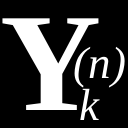
Explore the Yagel Grid
A pair \( (k, n) \) fully determines its Yagel number, so this page computes the exact value in your browser — no server round-trip. Both faces of the grid are available:
$$ Y_k(n) = p_{k-1}\#\cdot p_k^n - 1 \qquad\qquad Y^{+}_k(n) = p_{k-1}\#\cdot p_k^n + 1 $$
\( Y_k(n) \) are Yagel numbers of the first kind (the −1 face; row \( k=1 \) gives the Mersenne numbers), and \( Y^{+}_k(n) \) of the second kind (the +1 face; column \( n=1 \) relates to primorial primes). Primality verdicts come from the project's precomputed index of deterministically proven results — see the proven-primes list and the living paper.
Find a Yagel Number
What "proven" means here
Every prime in the index carries a deterministic certificate — no probable-prime claims. First-kind numbers are proven with the Brillhart–Lehmer–Selfridge \( N+1 \) test (possible because \( Y_k(n)+1 = p_{k-1}\#\cdot p_k^n \) is fully factored by construction); second-kind numbers with the Pocklington \( N-1 \) test. Composite verdicts inside the tested ranges are exact as well. Cells outside the tested ranges are reported honestly as unknown.